
Why Modern Evidence Infrastructure Matters More Than Ever
Every Digital File Could Become Critical Evidence
Not long ago, a criminal investigation might have relied primarily on photographs, paper reports, and physical evidence collected at a crime scene.
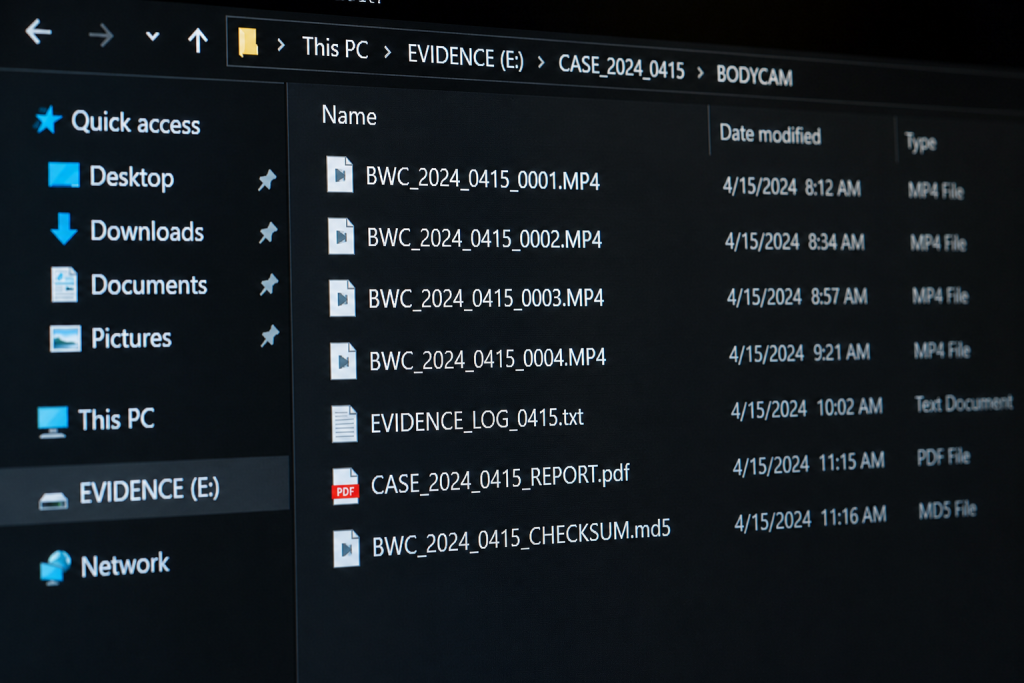
Today, a single investigation may involve terabytes of digital evidence, including body-worn camera footage, dash camera video, surveillance recordings, drone imagery, mobile phone extractions, forensic imaging, interview recordings, laboratory reports, and court documents.
As technology evolves, so does the responsibility to protect every piece of that evidence throughout its entire lifecycle.
For law enforcement agencies, digital evidence isn’t simply data.
It represents facts.
It represents accountability.
And in many cases, it becomes the foundation upon which justice depends.
The Volume of Digital Evidence Continues to Grow
The National Institute of Justice (NIJ) has identified digital evidence management as one of the fastest-growing operational challenges facing law enforcement agencies.
Body cameras generate hours of video every shift.
Patrol vehicles continuously record.
Public surveillance systems capture high-resolution footage.
Mobile device extractions can produce tens of thousands of files from a single investigation.
Even smaller agencies are now managing data volumes that would have been unimaginable only a decade ago.
As evidence continues to grow, agencies must consider more than simply adding storage capacity.
They must ensure that every file remains:
- Protected
- Searchable
- Accessible
- Secure
- Retained according to policy
- Recoverable after hardware failures or cyber incidents
Evidence Doesn’t Get a Second Chance
Unlike ordinary business files, digital evidence carries unique legal and operational responsibilities.
Questions that agencies must continually address include:
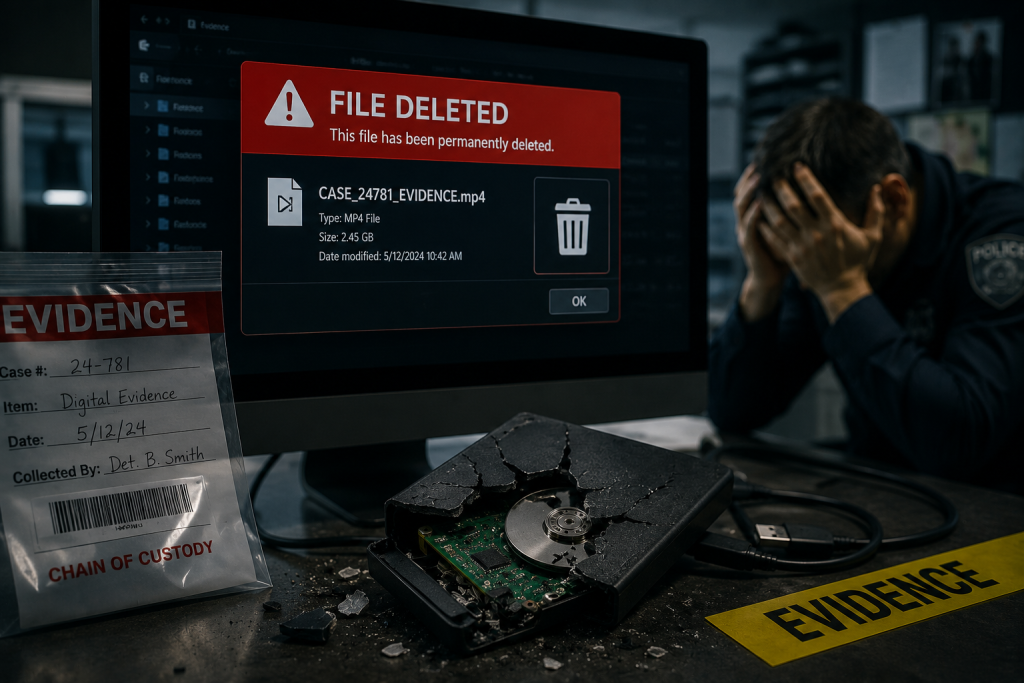
- How is evidence protected against accidental deletion?
- Can files be altered without detection?
- Is chain of custody preserved?
- Can investigators retrieve evidence years later?
- What happens if a storage system fails?
- How quickly can evidence be restored after a cyberattack?
- Are retention requirements being met?
Every answer contributes to maintaining confidence in the investigative process.
Beyond Storage: Building an Evidence Strategy
Modern digital evidence management isn’t simply about purchasing additional storage.
It involves creating an infrastructure that supports the complete lifecycle of evidence—from initial collection through long-term preservation.
An effective strategy should include:
Secure Primary Storage
High-performance systems designed for continuous evidence collection.
Reliable Backup
Multiple copies that protect against accidental deletion, hardware failures, or ransomware.
Long-Term Archive
Solutions that preserve evidence for years while helping agencies meet retention requirements.
Disaster Recovery
Recovery strategies that minimize downtime and protect investigations when unexpected events occur.
Cybersecurity
Layered protection that helps safeguard sensitive evidence from unauthorized access or malicious attacks.
Did You Know?
- 56% of agencies surveyed lacked a computerized forensic evidence tracking system. (National Institute of Justice survey)
- Digital evidence volume continues to grow rapidly as body cameras, mobile devices, drones, and surveillance technologies become standard investigative tools. (National Institute of Justice)
- Modern software-based evidence management systems can help preserve evidence integrity, improve accountability, and support long-term preservation. (National Institute of Justice)
Experience Matters
For more than 35 years, LH Computer Services has worked with organizations that depend on reliable, mission-critical technology.
Our approach is never one-size-fits-all.
We begin by understanding your agency’s current environment, future growth, retention requirements, workflows, and operational goals before recommending a solution.
Whether you’re planning for expanding body camera programs, growing forensic workloads, long-term archive requirements, or infrastructure modernization, our objective remains the same:
Help your agency protect digital evidence with confidence, today and for years to come.
Let’s Start the Conversation
If your agency is evaluating digital evidence storage, backup, archive, cybersecurity, or infrastructure planning, we’d welcome the opportunity to learn about your environment and discuss practical strategies tailored to your needs.